RESEARCH GUIDE
Could satellites support photosynthesis on Mars?
Satellites could be studied as a way to relay reactor telemetry, schedule experiments, and test tuned optical delivery to a contained surface reactor. Goldstar Orbital presents that as a research direction. Oxygen yield, energy advantage, and any contribution to terraforming Mars remain unproven.
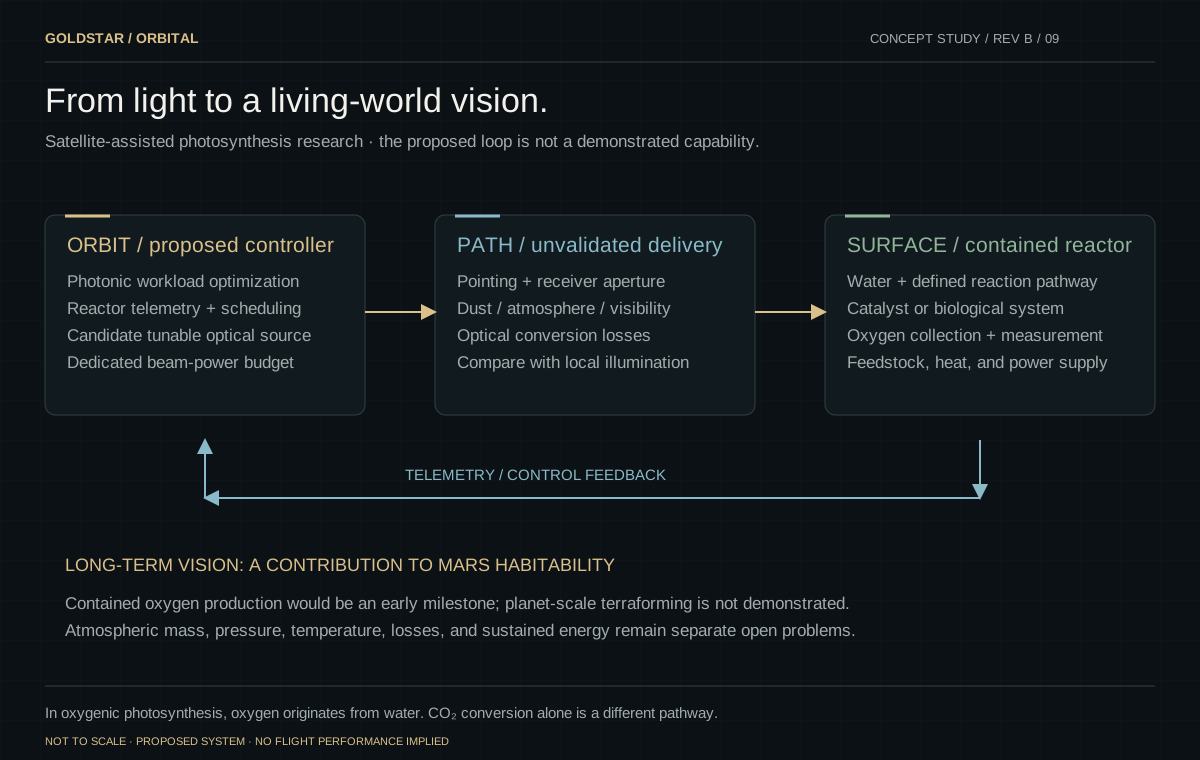
What is the proposed satellite-to-surface loop?
The Goldstar Orbital photosynthesis drawing links three research areas: an orbital controller, an optical path, and a contained surface reactor. Sensors would report temperature, illumination, and oxygen output. The controller could help schedule tests or choose experimental settings. A future optical payload could study tuned illumination during available contacts.
Those are proposed functions. The reactor needs its own feedstocks, chemistry, power supply, thermal control, and oxygen collection. Sharing telemetry or computation with a data satellite does not mean that the same hardware supplies everything needed to run a chemical process.
What produces the oxygen in photosynthesis?
In oxygenic photosynthesis, released oxygen comes from water. Describing the entire process as a generic “CO₂ to O₂” conversion hides the reaction pathway and energy requirements. Artificial photosynthesis and solar-fuel research study specific chemical routes; the Department of Energy's solar-fuels explanation describes water splitting and carbon-dioxide reduction as distinct pathways.
Before designing an orbital light source around a reactor, the experiment needs a defined catalyst or biological system, feedstock availability, illumination requirements, temperature range, and measured conversion efficiency. A wavelength that works for one process is not automatically optimal for a different one.
Would beamed light outperform power generated at the reactor?
That has to be measured. Our revision treats local illumination as a comparison case rather than assuming satellite delivery is superior. The total-energy boundary must include generation, conversion into useful light, transmission, pointing, atmospheric effects, receiver collection, and the reactor itself.
A good first experiment compares oxygen collected per unit of total input energy under equivalent reactor conditions. If an orbital control algorithm improves output, the comparison should still include the energy and complexity of communication and computation. Faster arithmetic cannot supply the reaction's energy or compensate for missing feedstocks.
The early goal is therefore a contained, instrumented test. That creates evidence about reactor behavior without assuming planetary-scale production from a satellite count.
What does MOXIE tell us—and what does it leave open?
NASA reports that MOXIE produced up to 12 grams of oxygen per hour at 98% purity or better. It is an example of reporting a measured result from a specific Mars experiment. It does not demonstrate Goldstar Orbital's proposed satellite-assisted photosynthesis loop, which uses a different system concept.
For our proposed experiment, comparable evidence would include the complete apparatus, environmental conditions, operating duration, energy consumption, and collected oxygen mass. Those measurements have not been reported by this concept study.
How does this relate to terraforming Mars?
Terraforming is the long-term vision, not a demonstrated outcome of the architecture. Creating oxygen locally does not resolve the mass and pressure of a planetary atmosphere, temperature, retention, or sustained energy supply. These are distinct problems that remain even if a contained reactor succeeds.
A NASA-reported 2018 study found accessible Martian CO₂ insufficient for its greenhouse-warming route using present-day technology. That work does not test this satellite concept, but it shows why a credible account of planetary transformation needs more than an oxygen-production estimate.
Our proposed sequence is to characterize a reactor, test whether satellite assistance adds value, and model any larger deployment from the resulting evidence. The site establishes no production yield or terraform-completion date. Explore the full research vision and the spacecraft requirements for the surrounding context.
Questions answered
Is satellite-assisted photosynthesis a demonstrated Goldstar Orbital capability?
No. It is a proposed research program requiring reactor experiments, energy and transmission budgets, environmental testing, and measured oxygen production.
Does making oxygen mean Mars is terraformed?
No. Local oxygen production does not resolve planetary atmospheric mass, pressure, temperature, retention, or the sustained energy supply needed for a habitable environment.
Does MOXIE validate orbital photosynthesis?
No. MOXIE is a separate Mars oxygen-production experiment. It offers a measured reference, but it does not demonstrate this proposed satellite-to-reactor system.