RESEARCH GUIDE
What does orbital data infrastructure need?
Orbital data infrastructure needs a complete spacecraft and network: power, heat rejection, attitude control, durable storage, communications, fault recovery, and ground access. Goldstar Orbital's concept separates compute controllers from active storage nodes and uses scheduled contacts to move data.
What do the controller and storage satellites do?
Goldstar Orbital's controller-and-storage drawing separates two roles. A controller schedules work, runs a proposed hybrid photonic accelerator, and coordinates communication. An active storage node manages persistent data with minimal local electronics. Both require spacecraft power, thermal management, attitude control, and a safe response to faults.
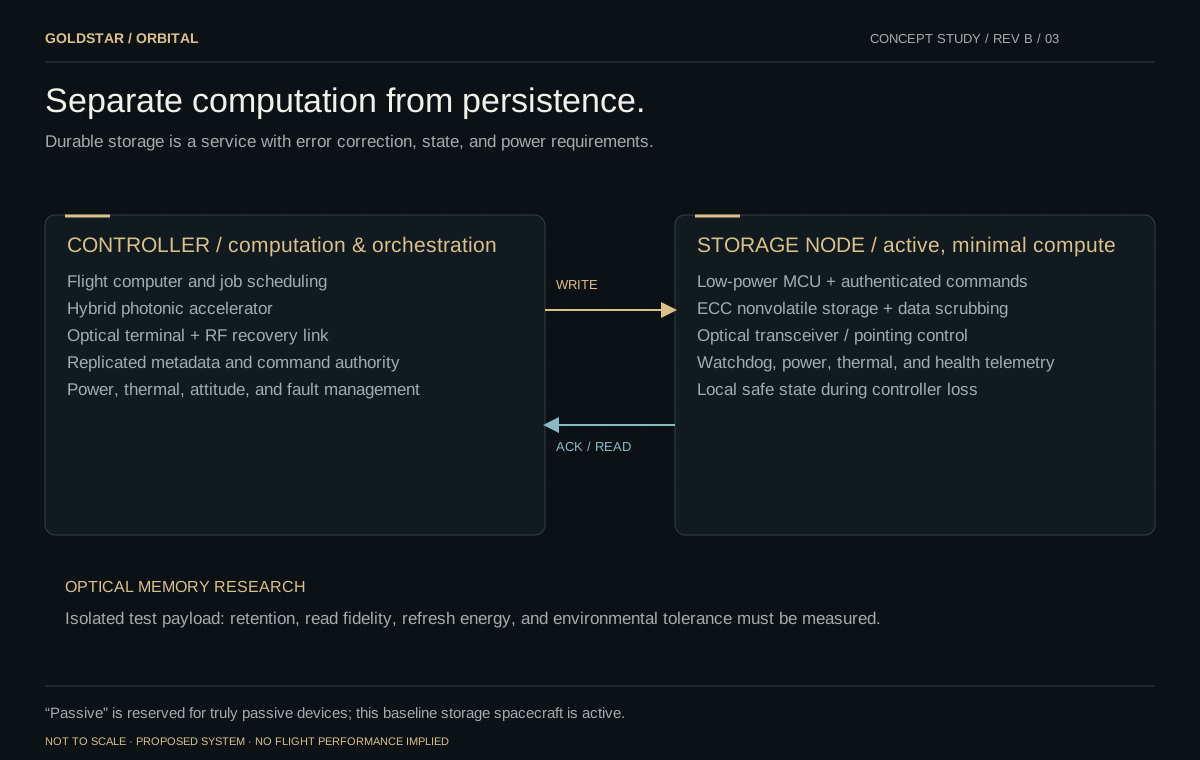
The word “active” matters: authenticating a command, correcting a storage error, aiming a link, and reporting health all require functions beyond a passive optical element. This revision keeps the storage service conceptually simple while giving it enough local responsibility to survive a lost controller contact.
How would an orbital data system reject heat?
Components pass heat through conductive paths to surfaces that radiate it to space. A spacecraft must also account for the energy it absorbs from its environment. NASA's small-spacecraft thermal guide explains these engineering mechanisms. The absence of convection is not the absence of a cooling problem.
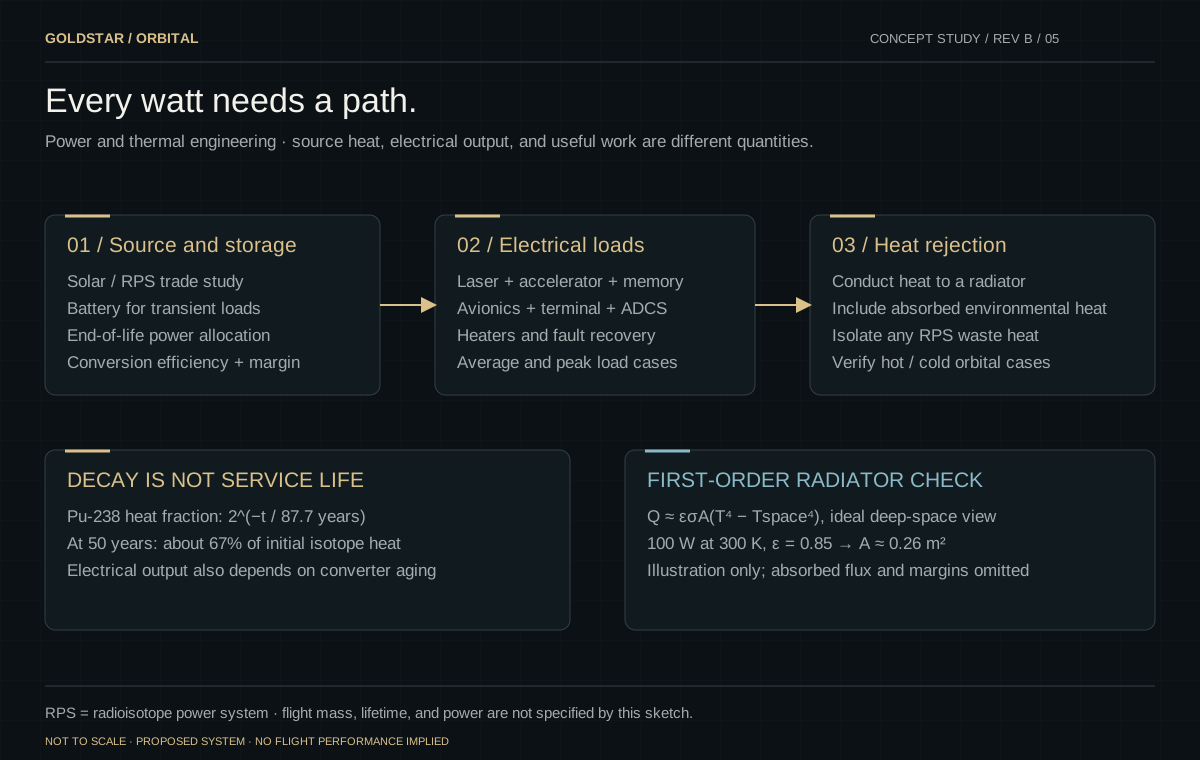
Our power and thermal schematic includes a simple check: for a 100 W heat load, an emitting surface at 300 K, emissivity 0.85, and an ideal 3 K sink, the Stefan–Boltzmann relation gives an emitting area of approximately 0.26 m².
A ≈ Q / [εσ(T⁴ − Tsink⁴)]
The assumptions make the example useful, and limited. It excludes sunlight, planetary infrared radiation, view factors, temperature gradients, radioisotope-source heat, and design margin. A real spacecraft needs hot- and cold-case models and environmental testing; this example is not a flight radiator specification.
Should the satellites use solar or radioisotope power?
That is a mission trade. The revised concept starts with solar and battery power for an Earth-orbit demonstrator and leaves a radioisotope option for later study. The choice depends on orbit, eclipse time, payload demand, mass, environmental conditions, and power available at the end of the intended mission.
NASA's Mars 2020 MMRTG reference describes approximately 110 W of electrical power at mission start. That is a reference system, not a specification for our node. Source heat, electrical output, and useful workload power must be tracked separately.
Using the 87.7-year Pu-238 half-life in the concept calculation gives about 67% of initial isotope heat after 50 years and 45% after 100 years. Conversion degradation and subsystem reliability still matter. See NASA's RPS background; isotope decay alone does not certify century-long service.
How do data links work when satellites cannot stay connected?
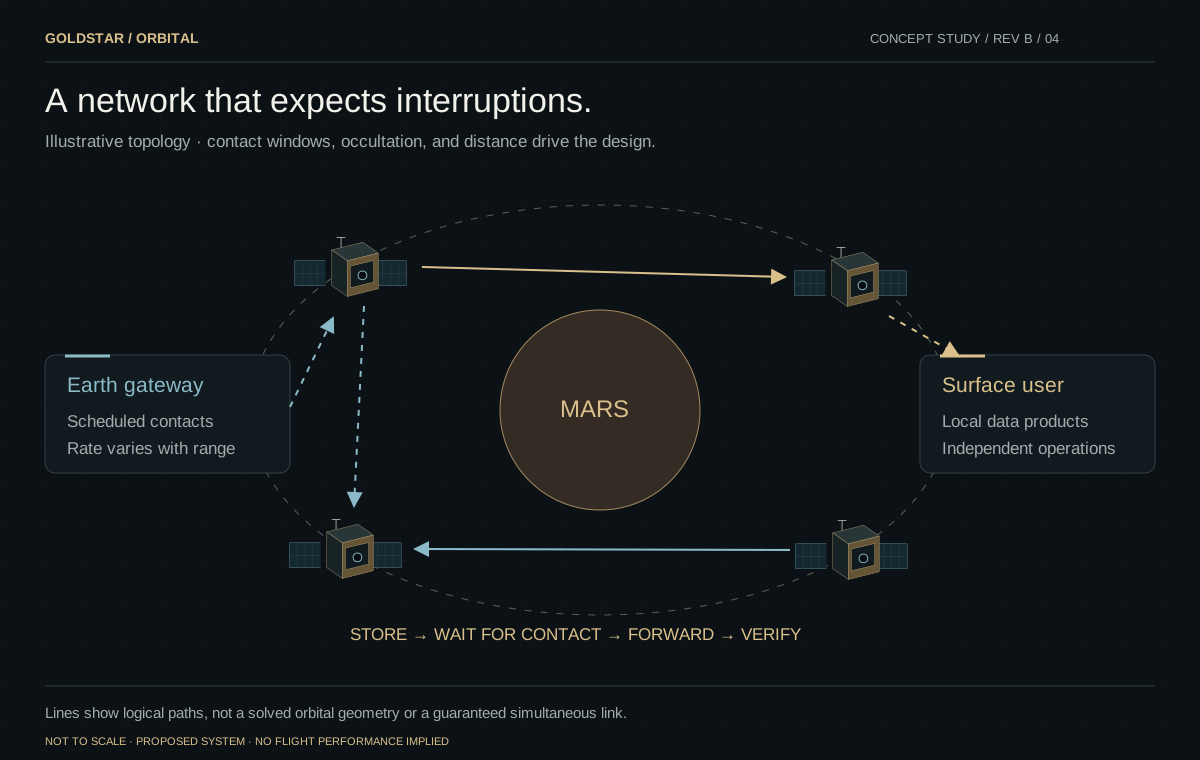
A useful design expects interruptions. The network concept buffers data until a scheduled contact, forwards it, and verifies delivery. It follows the architectural principle of delay/disruption-tolerant networking, which supports data movement across links that are not continuously available.
Local optical links and the Earth–Mars link need different budgets. Aperture, range, pointing errors, coding, and receiver sensitivity determine what is feasible. For context, JPL's DSOC experiment demonstrated 267 Mbps at 31 million km in December 2023. A result at one geometry cannot establish a universal rate for an entire constellation.
How much storage would a constellation provide?
First define tested usable capacity per node. As arithmetic only, assuming 10 TB per node gives 10 PB raw for 1,000 nodes, 1 EB raw for 100,000 nodes, and 10 EB raw for one million nodes, using decimal units. The assumption is not a measured storage density. Error correction, replication, spares, and unavailable nodes reduce usable capacity.
The development roadmap consequently starts with bench measurements and environmental qualification before an orbital demonstrator. Coverage, node count, replenishment, and economics should follow validated system budgets.
Questions answered
Does the vacuum of space eliminate cooling requirements?
No. Vacuum eliminates convection, but equipment still generates heat. Conductive paths and radiators must reject that heat while the design accounts for sunlight, planetary radiation, and orbital conditions.
Are the proposed storage satellites passive?
No. Revision B uses active storage nodes with minimal local electronics for error correction, authenticated commands, pointing, health monitoring, and survival.
Does an isotope's half-life establish spacecraft lifetime?
No. Isotope decay is one part of a power budget. Converter aging, component reliability, radiation, consumables, and environmental qualification also affect mission life.